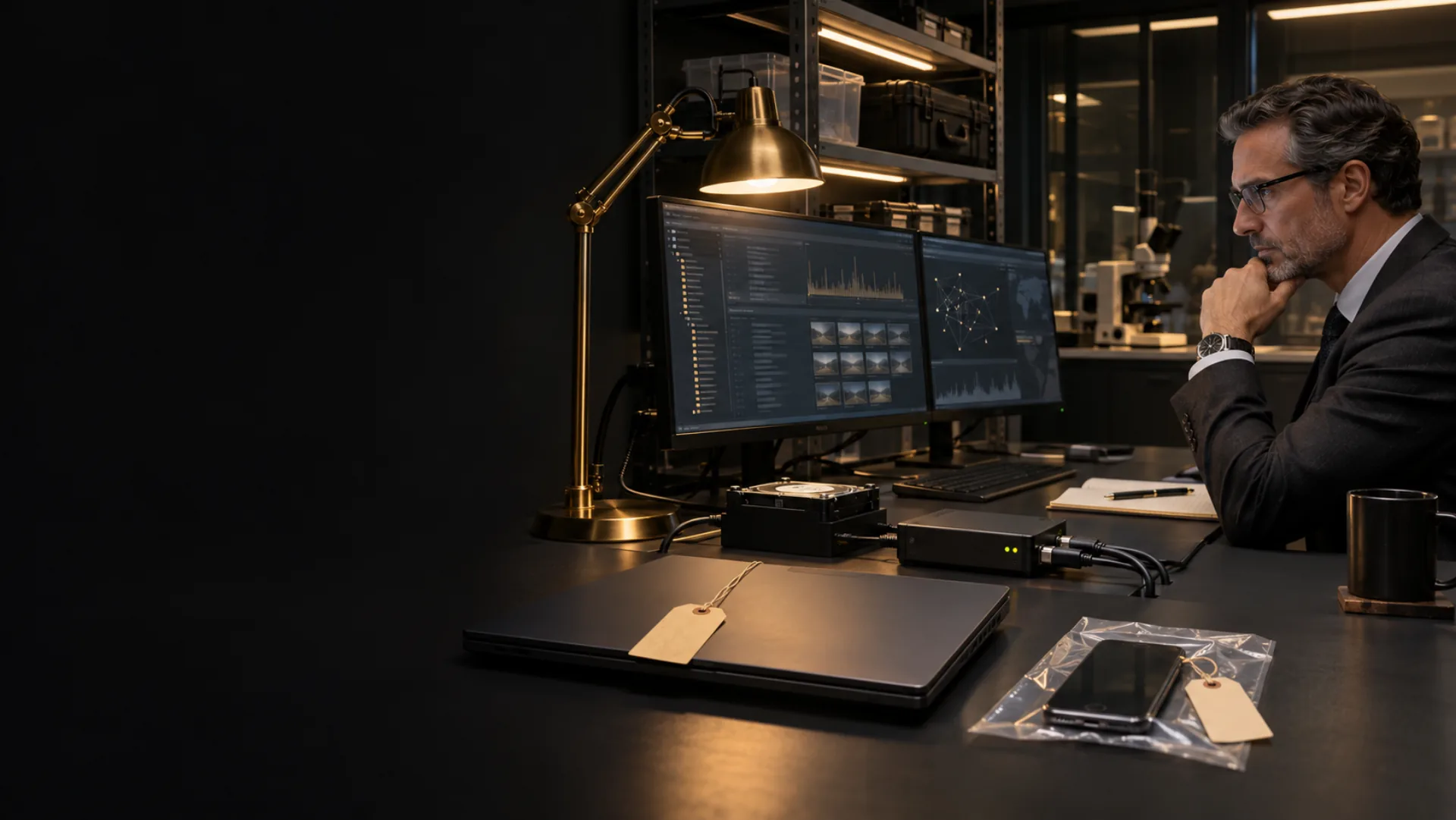
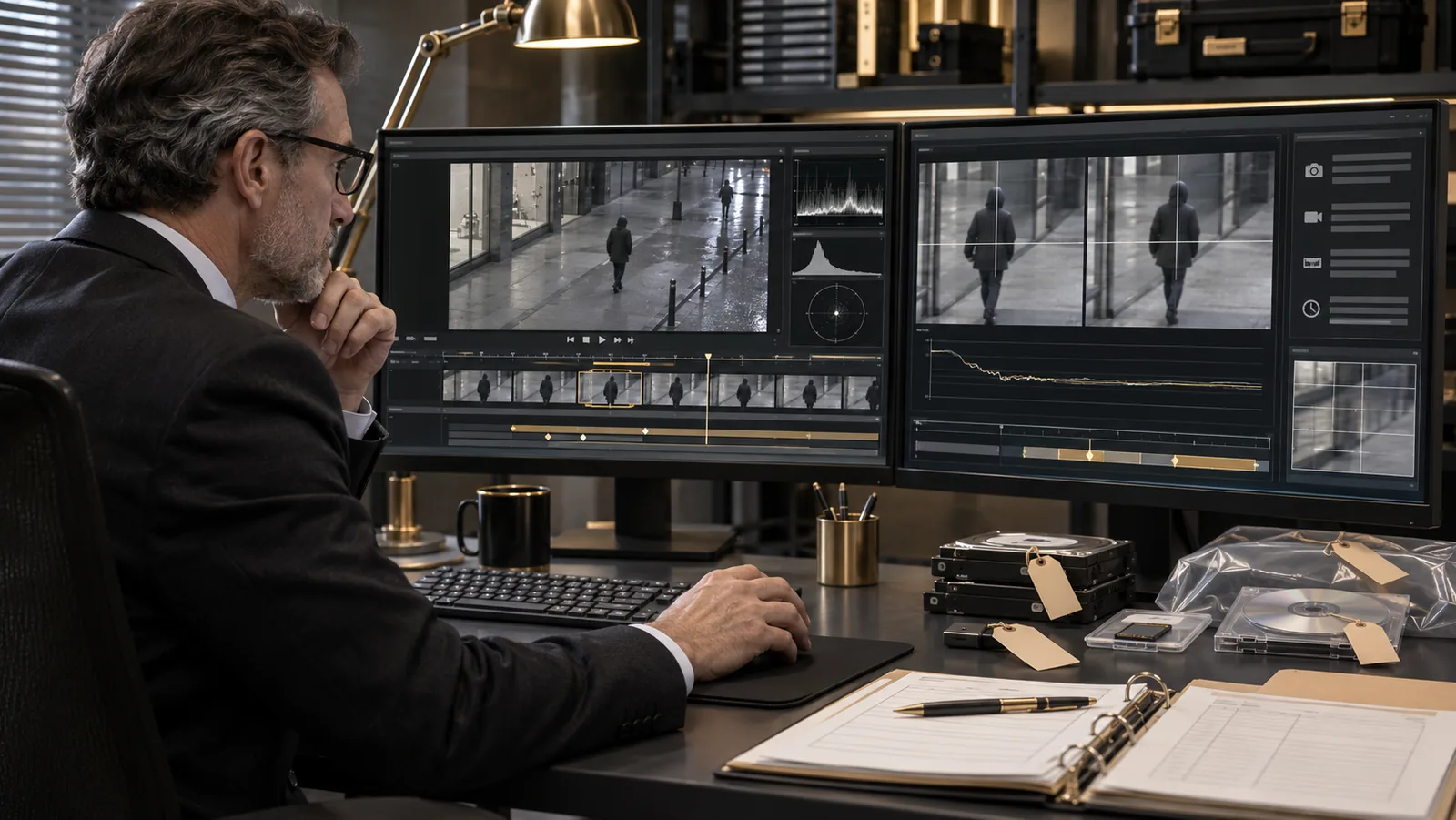
Video copied through messaging or social platforms may be recompressed, resized and stripped of metadata. Reliable analysis begins with the earliest available source and information about the recording system, export process and custody.
Frame review, timing analysis, stabilization and controlled clarification may reveal useful detail, but no process can create information that was never captured. Reports must describe transformations and limitations.
Video evidence examination
Forensic Video Analysis That Preserves the Source and Explains the Limits
Video evidence can appear straightforward because the viewer can press play, but the displayed clip may not represent the original recording. Surveillance systems use proprietary formats, variable frame rates, multiple camera clocks and export processes that can change quality or timing. Messaging applications, social platforms and screen recordings may resize, recompress or strip information before the file reaches an investigator.
Reliable video analysis begins with the earliest available recording, documents every transformation and never claims detail the camera did not capture.
FalconGate provides forensic video analysis for attorneys, businesses and individuals who need preservation, frame examination, timing review, controlled clarification and understandable reporting. The assignment may involve security-camera footage, mobile video, online media, vehicle recordings or a clip produced in litigation. The first questions concern the source, recording system, export history, custody and the specific fact the video is expected to address.
Forensic analysis can make existing information easier to examine, but it cannot create reliable detail that was never recorded. A blurred face cannot always be identified, a missing frame cannot be reconstructed with certainty and a timestamp overlay may not reflect the true event time. FalconGate distinguishes measured observations from interpretation and states the limits of the available pixels, frame sequence and recording system.
Preserving the Original Recording and Export Context
The strongest source is usually the native recording or earliest available export from the system that created it. A phone-recorded screen, social-media download or edited compilation may omit frames, audio, metadata and proprietary timing information. When possible, FalconGate requests the original export, relevant surrounding footage, player software and details about the camera or recording platform.
Preservation documents the file name, size, hash value, source, collection method and custody. Related camera views and a longer time window may be important because a short clip can remove context before or after the event. If only a derivative copy exists, analysis can proceed within that limitation, but the report identifies the source and avoids conclusions that require unavailable native data.
Native files or earliest available system export
Relevant footage before and after the disputed event
Player software and recording-system information
Related camera views and available audio tracks
Documented source, export method, custody and file hashes
Metadata, Encoding and Recording-System Review
File metadata can describe format, dimensions, codec, frame rate, duration and creation or modification times, but those fields must be interpreted in context. Export software may create a new file date, transcode the video or combine several recording segments. Some surveillance systems store timing information outside the visible file or use proprietary containers that require the manufacturer’s player.
FalconGate compares container metadata, encoded streams, frame sequence, visible overlays and known system behavior. Inconsistencies can indicate a conversion, incomplete export or editing step, but not every unusual field proves manipulation. The report explains which characteristics are normal for the source and which require further investigation.
Frame Timing, Synchronization and Event Chronology
A visible timestamp is not automatically the true time of an event. Camera clocks may be fast, slow, set to the wrong time zone or changed without documentation. Export players may display time separately from encoded frames. Variable frame rates, dropped frames and gaps can affect duration calculations and synchronization between cameras.
Timing analysis evaluates the frame sequence, metadata, overlay behavior, audio cues and external reference events where available. Multiple cameras can sometimes be synchronized through a shared visible event rather than their displayed clocks. FalconGate identifies the basis for every timing conclusion and reports uncertainty when the available source cannot support frame-level precision.
Visible clock and system-time comparison
Frame-rate, dropped-frame and gap assessment
Synchronization of multiple camera views
Event chronology using visual and audio reference points
Duration and speed calculations with stated assumptions
Stabilization, Clarification and Controlled Processing
Processing may improve the visibility of information already present. Stabilization can reduce camera movement, contrast adjustment can make tonal differences easier to see and controlled enlargement can help the viewer examine a region of interest. Frame averaging or noise reduction may be useful in limited circumstances, but every transformation must be documented and compared with the source.
Clarification is different from reconstruction. Generative tools can invent plausible details that were not captured, making them inappropriate as a basis for factual identification. FalconGate uses repeatable, non-generative processing for evidentiary analysis and preserves the unaltered source alongside any working or demonstrative output.
Authenticity, Editing and Completeness Questions
A request to determine whether video was edited requires a defined source and realistic standard. Transcoding, export, social-media processing and normal camera operation can all change a file without deceptive manipulation. Analysis may identify discontinuities, encoding changes, missing sequences, inconsistent metadata or other features that justify further review, but the absence of those indicators does not prove a complete history.
FalconGate separates evidence of ordinary processing from signs that may be inconsistent with the stated origin. Comparison with another copy, the recording system, export logs or surrounding footage can be more informative than examining an isolated clip. Reports state whether the available material supports a conclusion about continuity, source or alteration and where the evidence remains inconclusive.
Reports, Exhibits and Expert Communication
Deliverables may include a preservation inventory, technical file assessment, frame chronology, synchronized-camera presentation, clarification exhibit or expert report. Representative frames are selected with references to their position in the source, and every processing step is described. Demonstratives are labeled so the viewer can distinguish original imagery from enlarged, stabilized or adjusted versions.
For litigation, FalconGate can review another analyst’s methodology, evaluate enhancement claims and explain technical limitations to counsel. The analysis may support declarations, deposition preparation or testimony. Clear language is essential: the report states what can be observed, what requires interpretation and what the recording cannot reliably resolve.
Better Visibility Must Not Become False Certainty
Forensic video analysis protects the original recording, applies documented processing and communicates findings at the level the source can support. FalconGate helps clients understand useful detail without turning clarification into unsupported reconstruction.
Questions
Frequently Asked Questions
Can blurry video always be enhanced?
No. Analysis may improve visibility of existing information, but it cannot reliably reconstruct detail that the camera did not capture.
Why does the original video matter?
The original or earliest export may retain quality, timing, metadata and encoding information lost through messaging, editing or screen recording.
Can forensic video analysis determine whether a clip was edited?
Analysis may identify discontinuities, encoding changes or inconsistencies, but conclusions depend on the available source, export history and comparison material.
Can separate security cameras be synchronized?
Often, shared visible or audible events can help align camera views even when displayed clocks differ. Precision depends on frame rate, gaps and source quality.
Confidential first step
Bring the Question. Protect the Evidence.
Describe the matter, jurisdiction and deadline. FalconGate will review scope, conflicts and the safest next step.